
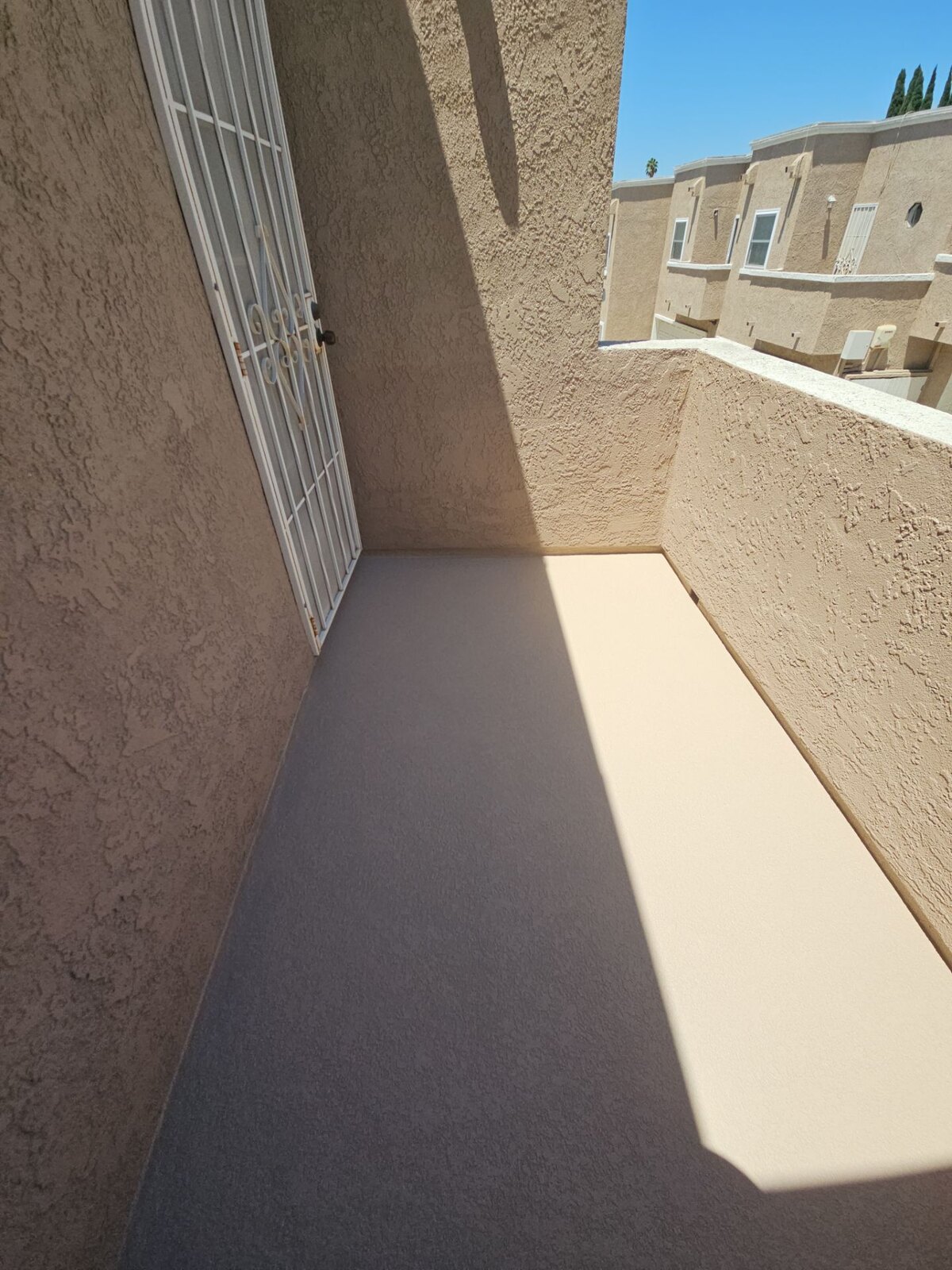
A practical guide to plywood deck, concrete traffic-coating, under-tile and below-grade waterproofing systems used on Los Angeles and Orange County properties.
Technical content reviewed by California Decking & Waterproofing · 40+ years of Southern California experience · CSLB #993188
Why waterproof a deck or balcony?
On a deck designed to keep water out of the structure or occupied space below, a continuous waterproof assembly helps protect the substrate and supporting materials. It must include the field membrane and the details at walls, doors, edges and penetrations. A decorative coating or water-repellent board finish does not automatically perform that job.
Waterproofing needs a sound supporting surface and regular care. It cannot restore weakened framing, eliminate all future movement or guarantee that maintenance will never be needed.
The waterproofing is an assembly
A finished deck may look like one coating, but dependable waterproofing is created by several coordinated layers and details. The visible texture protects the surface and provides traction; the waterproof membrane and reinforced transitions below it do the critical water-management work.
Choosing a product without evaluating the complete assembly can leave the original failure point untouched.
The substrate controls what can be installed
Plywood, concrete and existing cementitious deck materials behave differently. Moisture, movement, cracks, fasteners, surface profile and previous coatings all affect adhesion and preparation. The receiving surface must be sound and compatible before a new system is applied.
- Plywood condition and fastening
- Concrete moisture and cracking
- Existing coating adhesion
- Slope and low areas
- Contamination or incompatible materials
Most leaks begin at details, not open field areas
Drains, scuppers, door thresholds, wall transitions, edges, railing posts and pipe penetrations interrupt the flat deck surface. These locations need compatible flashing and reinforcement that connect continuously to the field membrane.
Drainage is part of the system. Even a well-installed membrane is placed under unnecessary stress when water cannot leave the deck efficiently.
Match the system to the surface and use
A plywood balcony, concrete apartment walkway, tiled terrace and below-grade wall do not have identical demands. Start with the application below, then confirm the substrate condition, exposure, traffic and required details before a system is specified.
Systems by application
Materials we evaluate for each condition
Life Deck AL-Flex
A reinforced acrylic walking-deck assembly using metal lath and fiberglass for appropriate, properly prepared plywood surfaces.
Plywood deck waterproofingLife Deck MC, Tremco Vulkem 350, Westcoat & Multicoat
Traffic-rated systems selected for prepared concrete balconies, walkways, stairs, rooftop decks and other pedestrian areas.
Walking-surface waterproofingCIM 1000
A two-component, liquid-applied urethane membrane used for appropriate under-tile assemblies, planters and other concealed waterproofing conditions.
Under-tile waterproofingTREMproof 250GC
A single-component, rapid-curing fluid-applied elastomeric membrane for appropriate below-grade concrete and masonry applications. It is protected or covered as part of the finished assembly—not used as an exposed walking surface.
Below-grade waterproofingThe correct system depends on substrate condition, moisture, exposure, traffic, transitions and the project specification. Products from different manufacturers are not combined unless the approved assembly allows it.
Common questions
Quick answers about waterproofing materials
What is the best waterproofing system for a plywood deck?
There is no single product for every plywood deck. The plywood must be sound, properly fastened and prepared, with suitable slope and compatible edge, wall and penetration details. Life Deck AL-Flex is one reinforced walking-deck system we evaluate for appropriate plywood balconies, decks and walkways.
What waterproofing membrane is used under tile?
CIM 1000 is a liquid-applied urethane membrane we consider for appropriate under-tile and other concealed waterproofing assemblies. Tile is the finish—not the waterproofing—so preparation, transitions, terminations and the complete approved assembly still matter.
What is used for below-grade waterproofing?
TREMproof 250GC is one fluid-applied membrane we evaluate for appropriate below-grade concrete and masonry conditions. The concealed membrane must be coordinated with surface preparation, protection and the rest of the specified below-grade assembly.